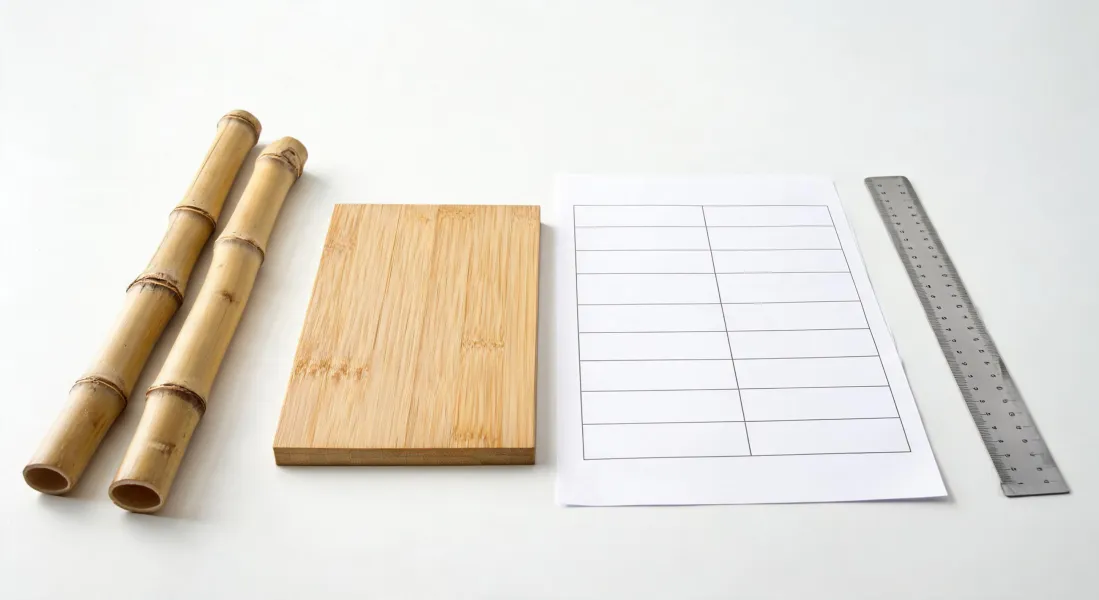
Most visible cracks on bamboo are drying stress, not a strength verdict. The usual cause is sudden drying and direct sun, not a load the piece failed to carry. That makes a crack a bargaining point, not a walk-away. Here is the case that breaks it: if the piece is headed into soil contact, or it is sold to you as load-bearing and the seller will not put a structural rating in writing, skip it no matter how clean the crack looks. A tidy sample tells you nothing about the bundle behind it.
The order you check things in matters more than the crack count. Ends and sun-facing faces first, because that is where drying stress shows. Fastener lines second, because a split at a nail is a different problem with a different owner. Anything that sat on or near soil last, because that is where the expensive surprise is. None of this hands you a pass or fail from a photograph, and I would not trust a seller who claims it does.
Cracks in Bamboo Are Stress Marks, Not Always Failures
A crack running along a pole usually traces back to how fast the material lost moisture and how much sun it took while it did. Sudden drying puts the outside of the culm under tension while the core is still holding water, and the outer surface gives first. The sun does most of it. That is why checking shows up on the sunny side and around the ends more than on the shaded face.
Cracks do not really weaken the culm. What they do is open it up. A crack is a doorway for decay organisms, and decay, not the split line, is what ends a post's working life. So the crack changes your inspection list rather than settling the purchase by itself.
Where that lands you depends on the service condition. Suppose you are buying poles for a covered hoophouse frame: a checked sunny face is a cosmetic note and nothing more. Put the same pole in a wet fence line and that crack is where water sits, so it becomes the spot you watch. Same defect, different money.
Splits Around Nails Tell a Different Story
A split that runs straight into a nail is not the same defect as a drying crack, and the responsibility sits with whoever drove the fastener. Nailing without pre-boring splits bamboo, especially thin-walled stock. When a split terminates at a fastener, that is an installation question for the seller, not a weather story.
The sorting test I use is where the split starts. A crack that radiates from an end or a sun-facing face matches drying. A split that runs along the fastener line, especially on a thin wall, matches the driving. If it sits on the fastener, raise it with the seller. If it does not, log it and keep inspecting the bundle.
Ask two things while you are still at the truck: where was this piece fastened, and were the holes pre-bored. A supplier who cannot answer either one is telling you something about how the rest of the batch was handled. You are not making a pass or fail call from a photo, and neither am I.
Mud Tubes and Ground Contact Change the Risk
Ground contact rewrites the value of a crack. Subterranean termites reach bamboo at ground contact by building tube-like runways of soil and faeces up from the soil, so a colony can be working a piece that still looks sound from standing height.
So the ground line changes what a blemish is worth. Soil is a delivery route, and a crack is one more opening on it.
I am not going to tell you what to apply or how to treat a post. Anything about treatment goes to the supplier as a written question, along with what they will stand behind on ground contact. Come back with a vague answer on that point and the vagueness is the finding.
Check Order From End Grain to Fasteners
Here is the order I walk a delivery, running from the obvious to the expensive. Start at the ends and the sun-facing faces, because drying stress shows there first and you can see it without breaking the bundle open. Note the cracks that run with the grain and stay clear of fasteners, and measure their length against the end grain so you have a size reference later.
Then follow the fastener lines, nail by nail, on both faces if the piece will turn. A split through the wall at a fastener stops the inspection: skip the rest of that bundle and ask for another. Cracks that stay clear of fasteners get written on the sheet and the walk continues, because you have not found a reason to stop.
Last, look at whatever sat on or near soil: the ground line, the base of the pallet, the corner that rested on the yard. Look for a tube of soil and debris stuck to the surface, which is what a runway looks like up close. By this step you already know whether the piece is going into soil at your place, so you know how much weight to put on what you find.
When to Reject, Replace, or Call the Seller
Now the calls themselves. Take a drying crack on a piece that will stay dry and off the ground: go with note it and move on. That purchase is fine, and pushing back on it costs you a working relationship over a cosmetic mark.
A split that lines up with a fastener through a thin wall is an installation fault, so take it to the seller rather than to the scrap pile. That one is theirs to answer, and the answer you want is about pre-boring.
A piece that has already sat in soil contact and carries a runway is the trigger to escalate instead of negotiate. The trade-off runs both ways here: pushing back on a good batch costs you a supplier, and accepting a bad one costs you a season. I would rather spend the relationship than the season.
What I will not hand you is a replacement deadline. The source material behind this piece gives no service-life number for your soil and your climate, and an invented one would be worse than none. Replacement and warranty terms get asked, not assumed.
Ask These Questions Before the Order Ships
Some things a crack photo cannot settle, and those are the ones worth an email before money moves. Current certification is first: which certification the supplier holds right now, not which one they have heard of. Adhesive emissions is second, and it matters more on laminated panels than on solid culm, because there is far more glue area to account for.
Food-contact suitability comes up when the run touches produce you sell: a display rack, a bin liner, a washdown table. Structural rating comes up the moment the words load-bearing appear anywhere in the sales conversation. Service-life guarantee comes up on anything headed into the ground.
On a food-contact run, or anything sitting beside livestock, ask for the specific documentation the supplier actually holds, not a description of it. On a piece sold as structural, ask for the rating behind the word. Answer either one with a picture of a crack and the deal ends there, because a photo answers a question you did not ask.
Today, before you unpack anything: set the cracked piece on a flat surface, lay a tape or a fastener beside the crack, and photograph it so the size reads. Then send the supplier three lines, covering the certification they currently hold, the adhesive emissions documentation, and the structural rating behind the claim they made. Vague answers on ground contact are your answer, and that answer is not a discount.
