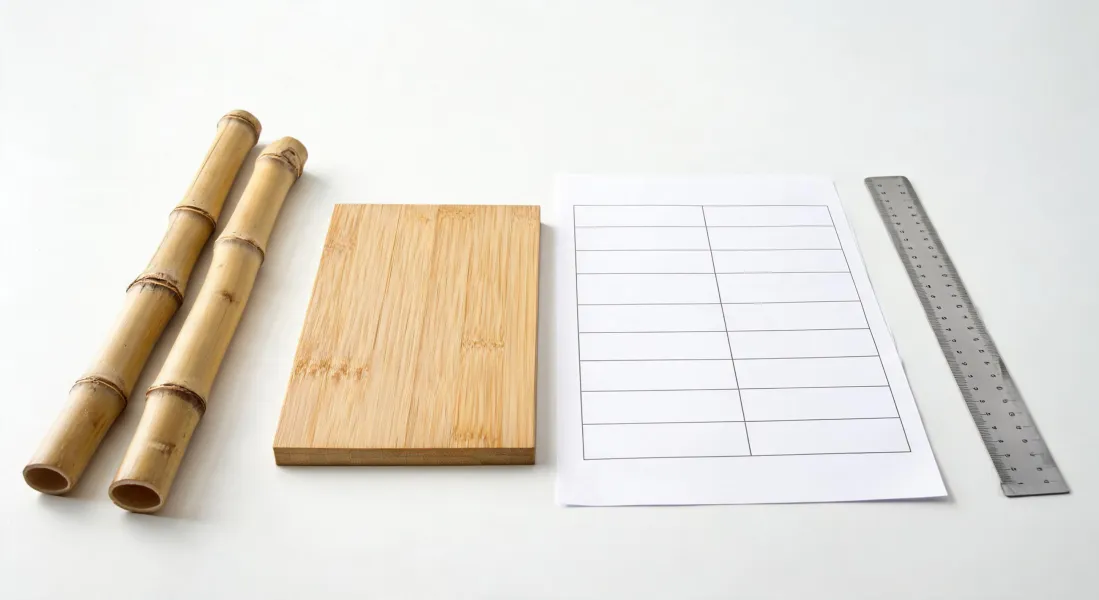
Suppose a grower orders bamboo panels cut to length for a washdown bench and a run of greenhouse staging, installs them in October, and by February the joints have opened, two panels have cupped at the edges, and the coating is lifting along the seams. Nothing on the invoice was wrong. The price was fair, the finish looked right in the yard, and the supplier did say kiln dried. The failure started weeks earlier, when nobody compared the moisture content the material had been dried to against the moisture it would settle into inside that building.
That gap outranks finish, species label and price per board. Not a fixed number everybody should demand, but the distance between the drying target the supplier worked to and the environment the piece will actually serve in, because that distance decides whether joints stay closed and coatings stay put. The invoice can be perfectly correct and the material still wrong for the building, and that combination is what this walkthrough is for, because it stays invisible at the loading dock and shows up weeks later.
What a Moisture Mismatch Costs a Grower
Shrinkage and swelling track moisture content directly, and the dimensional change a piece makes in service depends on how large a moisture swing it goes through. That single mechanism explains most of what a grower ends up calling bad material.
Picture the bench again, a season later. The cost does not show up as a defect you can reject on delivery; it shows up as rework. Panels that no longer line up with the framing, joints opening at the glue line, a top that cups away from its batten, coating lifting at the seams where water sits longest, and a batch that is cut, drilled and screwed before anyone thinks to check — which usually means it is yours, because return policies tend to end at the first machining cut.
The awkward part is that nothing was defective when it shipped. The piece was dried to one value, it moved to another value, and it behaved exactly the way bamboo behaves. That is why arguing about it after installation is a losing conversation and asking two questions before the order is not.
Why Wet Bamboo Is the Weaker Buy
Drying before use is a structural and service-life matter, not a cosmetic one. Dry bamboo is stronger and less susceptible to biological, thermal or chemical degradation than wet bamboo. In barn terms, a piece installed wet is weaker from the first day and is also a better host for whatever the building grows. The guidance behind this comes from laminated bamboo work published through INBAR and Nanjing Forestry University, covering furniture manufacturing and culm preservation; it explains the mechanism, and it is not a US product certification or a manufacturer's warranty.
So my bias, stated once: when I compare two quotes for a farm job, the stated drying moisture content ranks above the surface finish, above moisture-resistant wording, and above appearance grade. A supplier who cannot put a figure and a measurement method next to kiln dried drops to the bottom of my stack, however good the sample looks. The condition that flips it is worth naming. If the piece carries no load and fits against nothing, a plain baffle, a spacer, a liner that gets replaced every season, the drying figure can slide down the list, because a piece that is allowed to move and is not holding a joint has far less to lose.
There Is No Single Right Percentage
Buyers keep asking for the number, and there isn't one. The sensible target is the equilibrium moisture content that corresponds to the service conditions, meaning the value the material will eventually settle at where it is going to live. Dry to that and the piece has very little reason to move once installed. Miss it on either side and the material spends its first season in the building adjusting, which is the season you wanted it working.
The same guidance is blunt about wet stock: it cannot be glued effectively, treated well with preservatives, or painted. On a farm that reads as a laminated panel with a weak glue line, a coating that never bonded, and a preservative treatment that did not take, three failures that look like three separate problems and start as one.
Consider two growers buying the same panel from the same supplier. One uses it as a liner in an unheated, ventilated barn; the other fits it into a humid greenhouse that stays wet most of the year and gets washed down. Those are not the same drying target, and a supplier quoting one figure for both has either not thought about your building or is selling the only value they run. I am deliberately not printing a percentage for you to demand, because the right value follows the building rather than the catalog.
The Buying Walkthrough From Quote to Delivery
Write down the service environment before you contact anyone. Covered or open, heated or unheated, hosed down or kept dry, sitting against concrete or in free air, a bench that sees a wash every week or a liner behind a fan. One line in your own words, and every question after that hangs off it.
Then ask the moisture question in a form that cannot be answered with an adjective: what moisture content was this dried to, and how is it measured? Kiln dried answers neither half. A supplier running a real drying operation can give you the target and the method in one sentence, and the ones who cannot usually start explaining the finish instead.
Next, get the equilibrium value for your own conditions and compare it with the supplier's figure on the same basis. Plenty of arguments start because one number was taken from the surface of a stack while its counterpart came out of the middle of a board, or because the two were measured different ways. Match the basis first, or the comparison is theater.
Before money moves, get the remedy in writing. If the delivered reading does not match the stated target, who pays for the return, what comes back, and does that include material already cut? A promise to work with you is not a remedy.
Last, verify twice. Once on arrival, which tells you what shipped, and again after the material has sat in its final environment, which tells you what you actually own.
One Deciding Point at Each Step
At the first step, the only thing that decides anything is how precisely you can describe where the piece will live. A vague description makes every later question slightly wrong, and you end up comparing figures for two different buildings without noticing.
What decides the second step is whether the answer contains both a figure and a method. I ask the same question twice in different words, and I want to hear the same number come back; when the answer changes, the first one was a habit rather than a spec.
The third step turns on whether the two values were measured the same way, because a factory target compared against a barn figure taken by another method proves nothing in either direction. The fourth is about paper: whether the remedy exists in writing before payment, since everything ahead of that point is talk, and talk is cheap right up until a cut panel is on your bench.
One sheet can still answer differently for two buyers. The grower stacking panels in an unheated barn and the grower fitting them into a wet greenhouse are asking about the same product and need different targets, and the supplier who says so out loud is the one I keep talking to.
How to Confirm You Got It Right
I take meter readings across several boards rather than one, because a reading off the top of a stack describes the top of the stack. Each one gets a date and a note about where in the bundle it came from, and I compare those against the equilibrium value for the building the material is headed for.
After that I let the stack sit in that building before anything is cut. Waiting is the cheapest check available: if the readings drift once the material is in place, I have learned about the mismatch before making an irreversible cut. I check the end grain at the same time for splits that were not there on delivery and for checks opening at the ends, and I look at the wrap, because I have found bottom courses sitting in their own condensation after a long ride. I noticed long ago that a bundle is never one moisture value; the boards on the outside and the boards packed in the middle do not dry the same.
If my reading and the supplier's figure disagree, that is a purchasing conversation with dates and locations behind it, not something to settle by guessing. I will not hand you a pass or fail number to compare against, because a threshold nobody can defend is worse than no threshold; what I can hand you is a dated record that makes the conversation with the supplier concrete.
What a Moisture Reading Cannot Tell You
Getting the moisture side right closes one door, not the house. Supplier certification, adhesive emissions, food-contact suitability, structural ratings and service-life guarantees all sit outside the drying question, and none of them can be inferred from a moisture figure. If the piece goes under food, a washdown bench, a packing table, a cutting surface for a farm kitchen, food-contact suitability needs its own answer for that product.
Here is the tradeoff in plain terms: hours spent on drying data come back to you as joints that stay closed and a coating that lasts, and they buy nothing at all on load rating or food contact. A load-bearing use needs a load answer, in writing, for the exact piece you are buying.
This is not for the buyer who wants one universal percentage to paste into a spec sheet and stop thinking, because no such number is defended here and I would side-eye anyone who hands you one. It is for the grower who can describe the barn, greenhouse or washdown bay the bamboo will live in, will spend two extra questions before signing, and will put a meter on the load before anything gets cut.
