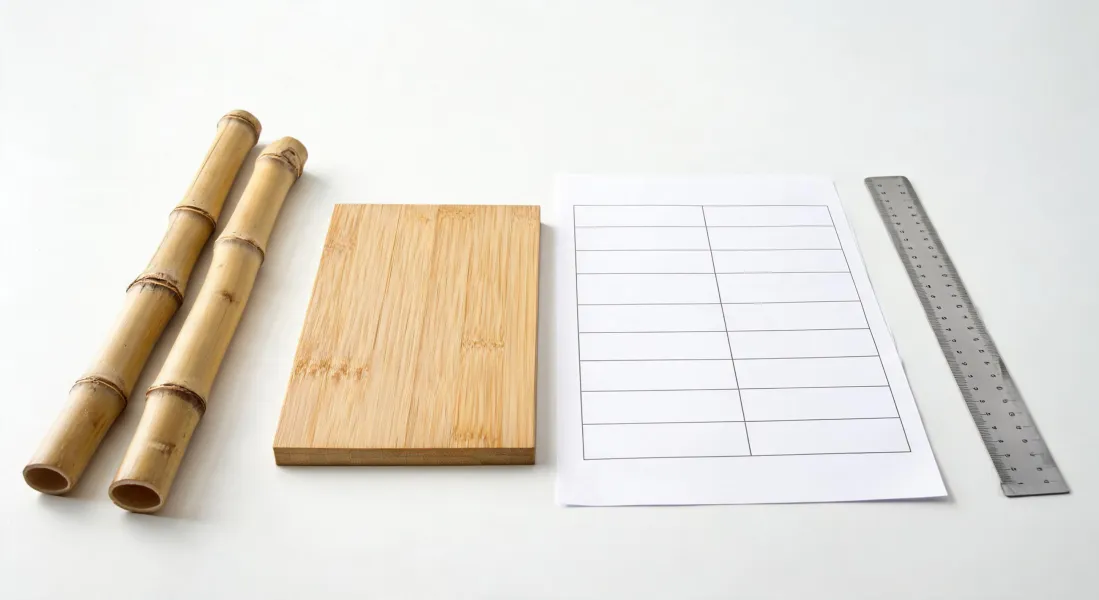
A culm that reaches the glue room wet can come back as a bench whose joints open in the first dry winter, or a tabletop that cups after one humid summer. A culm dried to the moisture it will live at in service, planed into rectangular strips and glued in jigs can come back as a subassembly that still holds its shape when the fittings go on. Same species, same saw, same sawdust on the floor. The difference is the order of operations, and whether the seller can describe that order without reaching for the word strong.
For a grower or farm equipment buyer pricing workbenches, packing benches or equipment supports, that order is the useful test on a spec sheet. Strength claims travel easily between products. Process descriptions do not, because they have to be specific to be worth anything. Work through the questions in the sequence a shop floor has to answer them: what has to happen to a culm at all, what has to be true before any adhesive touches it, why the strips have to change shape first, what the jigs and the coating are actually holding together, and where the paperwork behind a claim runs out.
What turns a bamboo culm into furniture?
Begin with the smallest honest description of the process. Culms are split into rectangular sections; the sections are glued together in jigs to make subassemblies; the subassemblies are assembled, fittings are added, and the piece is finished with lacquer or another coating. That is the whole furniture-making arc in one sentence, and it contains five places where a cheap shop and a careful shop diverge.
Treat those five as gates rather than steps in a recipe. Splitting, planing, gluing, assembly and finishing each have their own pass condition, and no later gate repairs an earlier one. A perfect lacquer film will not close a glue line that never had flat faces to bond. New fittings will not straighten a subassembly that was clamped out of square while the adhesive cured. There is no single bamboo material decision to make. There is a chain of decisions, and the piece you receive reflects the weakest link in it.
The chain also explains why two pieces that look identical on a showroom floor can behave differently in a barn. One shop may run a documented drying step and a planer set up for rectangular strip; another may buy strips in and assemble. Neither is automatically wrong, but the questions you ask change depending on which one you are talking to. So what has to be true before a single strip goes into a jig?
Why must bamboo dry before gluing?
Bamboo should be dried to the equilibrium moisture content that matches its service conditions before it enters secondary manufacturing. The reason is not tidiness. Wet bamboo cannot be glued effectively, cannot be treated well with preservatives, and cannot be painted. One upstream miss, three downstream failures, and all three are the failures a buyer notices in year two rather than at delivery.
Read that list again as a buying screen. Adhesive performance, preservative treatment and coating adhesion are three separate promises a supplier is making, and all three rest on the same drying step. A seller who can say what moisture content the stock is dried to, and which service conditions that target was chosen for, is describing a controlled process. A seller who answers that it is kiln dried, with no target and no service condition, has given you a word rather than a spec.
Service conditions are where your own situation enters. A bench in an unheated Midwestern barn and a bench under a covered porch in coastal Georgia are not the same service environment, and the moisture target that suits one may be wrong for the other. Ask which one the supplier designed around. The guidance behind this drying step is historical manufacturing research on laminated bamboo furniture, not a current US product certification, so treat it as the logic the process has to satisfy, not as a stamp on any particular shipment. Then look at the strips themselves: what shape does a glue line need?
Why plane curved splits into rectangles?
A bamboo split is not a board. It is curved in cross-section, because it came off a round culm. Laminating requires a rectangular cross-section, so a rough planer is necessary to remove the nodes and the green epidermal layer and produce strips with a rectangular transverse section. That is a manufacturing requirement, not a styling choice.
Why does the geometry matter so much? Because the point of lamination is controlled contact between faces. A curved split meets its neighbor along a narrow line. A planed strip meets it across a face, and the stack stays where the clamp put it instead of rolling. The planer is also doing a removal job with no substitute: nodes and the green outer layer come off, they are not glued around. A supplier whose story stops at solid bamboo has skipped the step that makes every later step possible.
Ask what happens between the split and the glue. If the answer is a planer and a rectangular strip, the shop is describing the geometry the laminating step depends on. If the answer is that the poles get pressed, or that the whole culm is used, you are looking at a different product with different behavior and should price it as one. There is nothing dishonest about poles. There is something misleading about calling them laminated. Once the strips are dry and rectangular, what actually holds them in shape while the adhesive sets?
What do glue, jigs, and finish actually do?
Strips become furniture through adhesive and clamping. Rectangular sections are glued together in jigs to produce subassemblies, and the jig's job is to hold the geometry while the adhesive does its work, so the shape that leaves the press is the shape the assembly step inherits. After that the subassemblies are assembled, additional fittings are added, and the furniture is finished with lacquer or another coating.
Notice the order of authority. The jig governs the subassembly; the subassembly governs the assembly; the coating governs nothing except the surface it sits on. A lacquer film can make a mediocre glue line invisible for a season, which is exactly why photographs of finished samples are weak evidence of process. If you want to see the part that decides how the piece ages, ask for an unfinished subassembly, a stack taken straight out of the jig before fittings and before finish.
The same logic applies to hardware. Brackets, bolts and fittings are chosen for the loads and the movement the piece will see, and they can only be as good as the subassembly they are fastened to. When a description jumps from bamboo being a renewable material straight to a photograph of the finished bench, the middle of the process has gone missing, and the middle is where the useful questions live. So which supplier answers that sequence in order, and which one changes the subject?
Which supplier passes the process test?
Put the process questions first and rank on the answers. Adjectives are not a shortlist.
The screen has an order, and the order is the point. First, can the supplier say what moisture content the stock is dried to and which service conditions that target matches? Second, can it describe planing curved splits into rectangular strips and removing nodes and the green layer? Third, can it describe gluing those strips in jigs into subassemblies? Fourth, can it describe assembly, fittings and final coating as separate stages? Suppose two suppliers quote the same bench. Supplier A answers all four from its own floor, naming stages rather than slogans; move it forward and start talking price, delivery and spares. Supplier B answers the first question with kiln dried, the second with solid bamboo, and the fourth with a sustainability paragraph; hold it back until the process answers arrive, because nothing in that reply tells you which gate is being controlled. Exclude on missing process answers, not on the absence of a brand name you recognize. A small shop that can describe its drying target and its jig setup is a better bet than a large one that cannot.
One caution about that ranking. A supplier answering well is telling you the process exists. It is not telling you the finished product has been rated for your load, your span or your climate. Keep the process screen and the document screen apart, because they answer different questions, and one cannot cover for the other. Which of the claims you actually need does none of this touch?
What is still unproven?
Several things a farm buyer might reasonably want sit outside any process description. Current supplier certification, adhesive emissions, food-contact suitability where a surface may hold produce or feed, structural ratings, and service-life guarantees are all separate questions about a specific product and a specific use. They have to be requested as such, and they are not established by knowing how the culm was handled.
Ask in writing, name the exact product and the intended duty, and expect a document rather than a sentence. Low emissions is a phrase; an emissions report is a document with a product name on it. Rated for heavy loads is an adjective; a structural rating is a test result tied to a span, a support condition and a stated safety factor. If a supplier cannot produce the document, the honest reading is that the claim is unverified for your application, which is different from saying the product is bad.
There is a boundary on the process description itself. What is described here comes from published guidance on laminated bamboo furniture manufacturing: specific, useful, and historical. It is not a US certification, not a test report on the bench you are buying, and not evidence about a particular shipment. Use it to interrogate a supplier. Do not use it to certify one.
The objection left over is usually this: if the process is this well defined, why do supplier claims differ so much? Because a process description is cheap to paraphrase and expensive to document, and price competition rewards the paraphrase. What differs between two quotes is rarely the chemistry. It is the paperwork behind it. So the last move is not another question. It is a written request for five items attached to the exact product you intend to buy: current certification, adhesive emissions, food-contact suitability if the surface will touch produce or feed, a structural rating with its span and support conditions, and a service-life guarantee with its exclusions listed. Send it before you send a purchase order. A supplier who answers has told you more about the bench than any brochure will, and a supplier who cannot has told you something worth knowing too.
